
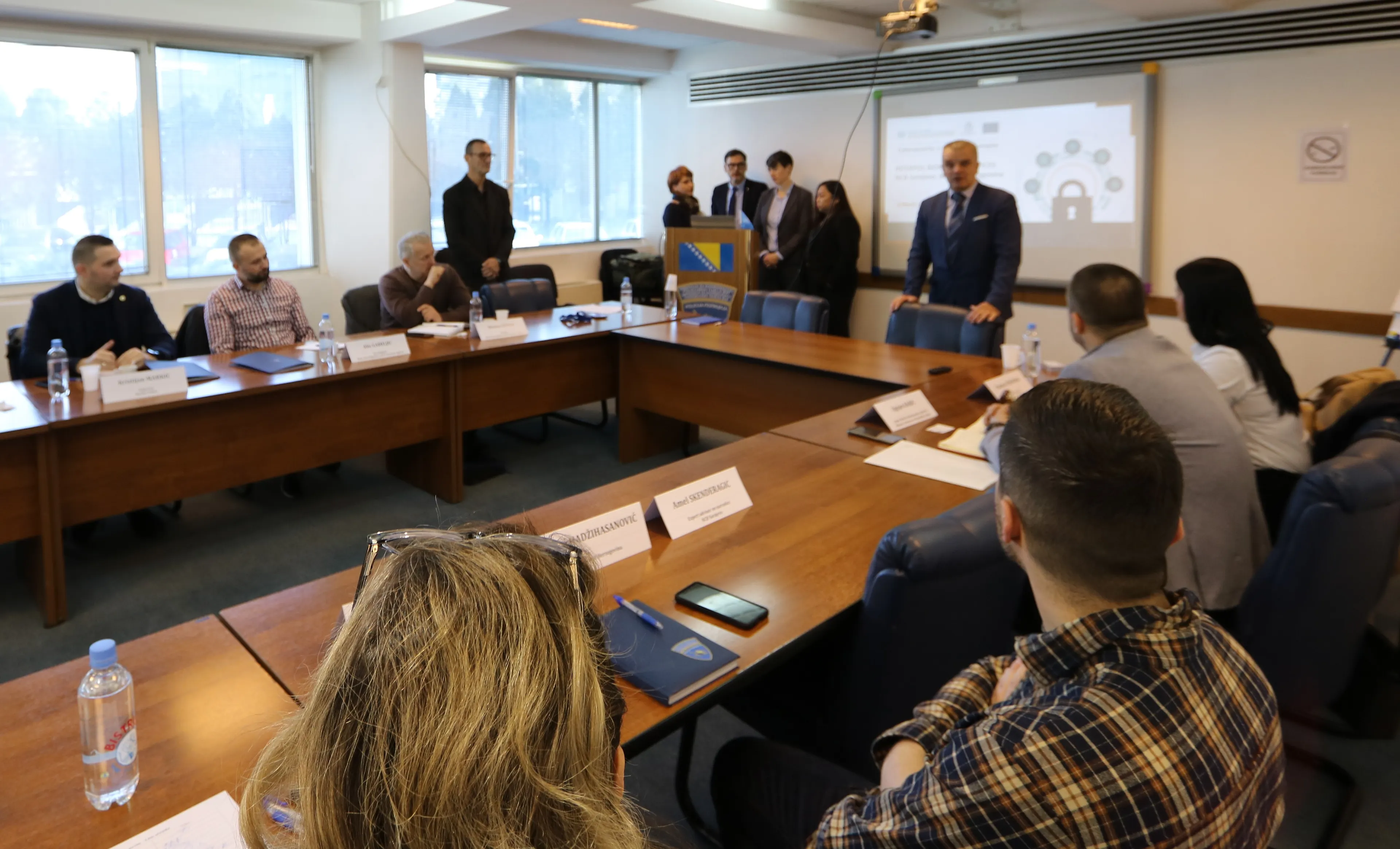
International training in the field of identification based on Facial recognition and training on INTERPOL Biometric Services, organized by the Counter-Terrorism Directorate (CT) of the General Secretariat of INTERPOL and the Directorate for the Coordination of Police Bodies of BiH, were successfully conducted in Sarajevo from 5 to 8 March 2024.
Both trainings were implemented within INTERPOL's CT-TECH Project, a joint project of INTERPOL and the United Nations Office of Counter-Terrorism (UNOCT), which aims to help member countries to strengthen the capacity of law enforcement agencies to combat the use of new, modern technologies for terrorist purposes and to enhance their operational, investigative and analytical capabilities.
The officers of police agencies from several countries, namely three officers from Albania, Azerbaijan and Egypt and six officers from the police agencies from Bosnia and Herzegovina attended the international training in the field of identification based on Facial recognition, while the training on INTERPOL Biometric Services was organized exclusively for domestic agencies and was attended, in addition to the officers of the NCB Sarajevo Department, by two representatives of police agencies from Bosnia and Herzegovina, namely: the State Investigation and Protection Agency, the Service for Foreigner’s Affairs of BiH, the Border Police of BiH, the BiH Agency for Forensic and Expert Examinations, the Federal Ministry of the Interior, the Ministry of Interior of RS and the Police of Brčko District.
Both trainings were conducted by INTERPOL experts in the field of biometrics, and participants were introduced to new technologies and the use of INTERPOL's Facial Recognition System (IFRS), identification procedures and exploitation modalities of this advanced tool developed by INTERPOL as part of an integrated approach to its forensic capabilities, which, in addition to facial databases, include DNA and fingerprint databases. Almost 1,500 terrorists, criminals, fugitives, persons of security interest or missing persons have been identified since the launch of INTERPOL's Facial Recognition System at the end of 2016.
The new Bio-Hub platform was also presented to the participants. It is a state-of-the-art identification system which enables law enforcement authorities in member countries to forward fingerprints and photos for facial recognition, while powerful image comparison software compares them with data stored in INTERPOL's biometric databases, and the relatively new I-Familia database, which is a global database for the identification of missing persons, which, as a result of cutting-edge scientific research, seeks to identify missing persons or unidentified corpses when direct comparison is not possible, using DNA samples of family members. This is a complex process, and even more so when it is carried out at the international level, in which INTERPOL plays a unique role through its global network.