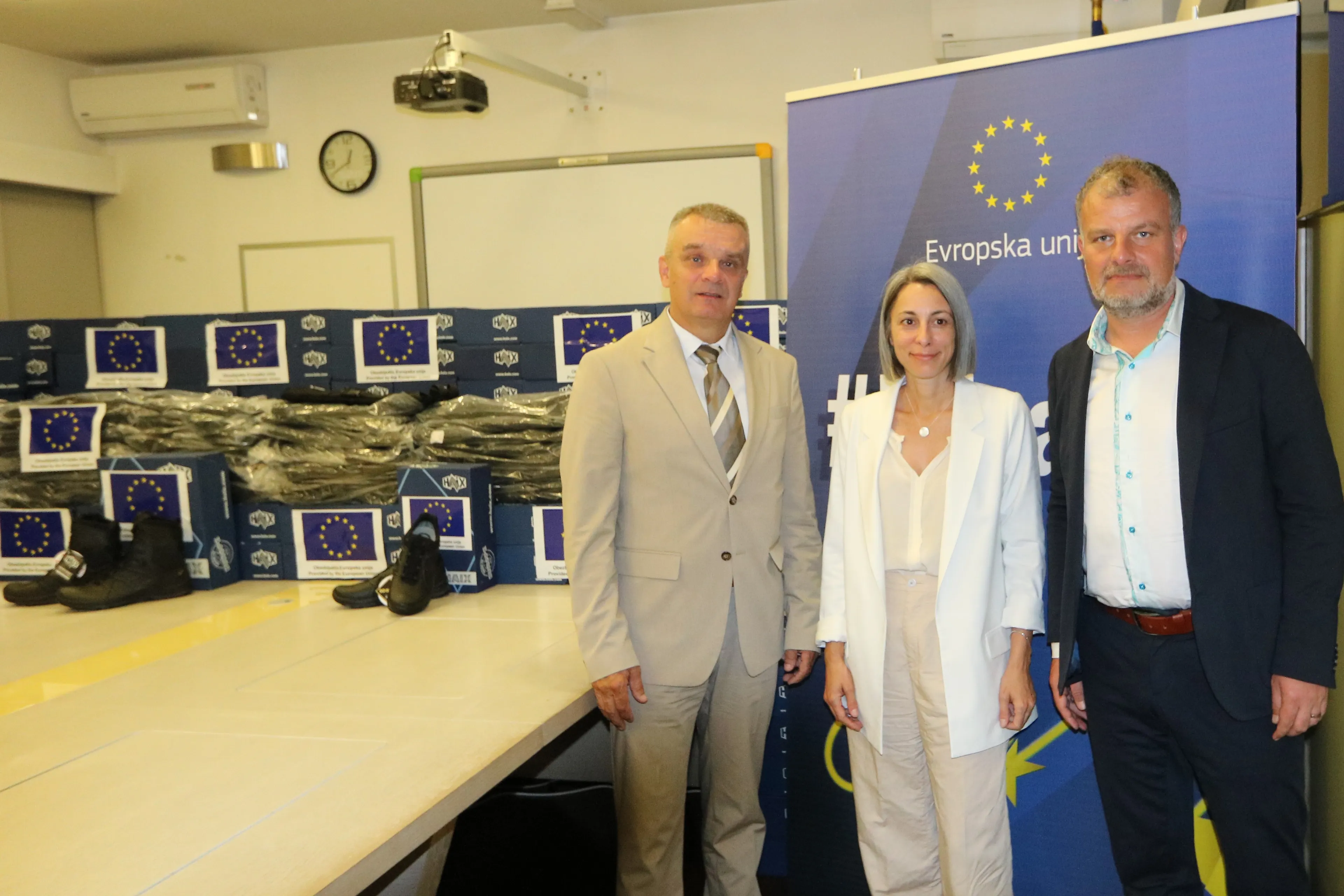
As part of continued support for the development of capacities for managing migration flows in Bosnia and Herzegovina, the European Union donated today equipment worth 170,900 BAM to the Directorate for Coordination of Police Bodies of BiH.
Karel Lizerot, Head of Section for Justice and Internal Affairs, Migration and Public Administration Reform at the Delegation of the European Union to Bosnia and Herzegovina, handed over the equipment to Director Enes Karić.
“The European Union invests in capacity building of agencies that are involved in responding to migration flows in BiH, including the Directorate for Coordination of Police Bodies of BiH. Our support will continue in the coming period”, Lizerot said.
This equipment includes specialized protective clothing and footwear and is part of comprehensive support to the work of the Directorate for Coordination of Police Bodies of BiH, which will significantly facilitate the work of police officers in the field. Namely, the European Union donated ten specialized off-road vehicles worth 725,000 BAM to the Directorate in March this year, which play a key role in increasing the mobility and operational efficiency of police officers.
Director Enes Karić presented activities aimed at building and strengthening the Directorate’s capacities, as well as activities embedded in the Strategic Plan for the Development of the Directorate that relate to strengthening communication, coordination and cooperation both with the police authorities in BiH and with international partners. He pointed out that one of the constant goals and priorities of the Directorate is strengthening material and technical capacities. He particularly emphasized the Directorate’s participation in providing security in Temporary Reception Centres accommodating migrants, where members of the Directorate provide physical protection and actively contribute to the safety and quality of life of migrants and employees. Director Karić also pointed out that the mentioned donated equipment is important for the quality performance of daily work and tasks of the Directorate’s police officers in the field.
Through the project “Individual measures to strengthen the response capacity to manage migration flows in Bosnia and Herzegovina”, the European Union provides significant support to the Ministry of Security of BiH, the Service for Foreigners’ Affairs, the Border Police and Sector for Asylum, the Directorate for Coordination of Police Bodies as well as other institutions and agencies that are responsible for this sector. One of the key components of the project is the provision of equipment, capacity building, and expert assistance for the establishment of an integrated migration and border management system in BiH.
An important turning point in capacity-building efforts in BiH took place at the beginning of 2022 when security services in the Temporary Reception Centres in Sarajevo Canton and Una-Sana Canton were officially handed over to the Directorate for Coordination of Police Bodies of BiH. This transfer of responsibility to the state is part of a wider initiative supported by the EU and with the support of the IOM, which includes strengthening the state's response to mixed migration through the procurement of equipment, and the strengthening of the capacities of the relevant institutions.
Thanks to the financial support of the EU, Temporary Reception Centers have been established in BiH since 2018 and their functioning is continuously supported, with IOM as the leading partner in the project. Migrants residing in BiH are provided with food and water, sanitation, clothing, psychological counselling and education services, as well as an integrated, fair, efficient, and transparent system of health services.
The European Union remains committed to supporting Bosnia and Herzegovina in managing migration flows in the country. Through joint efforts and continuous support, the EU aims to ensure the well-being and protection of migrants while supporting the leading role of the state in responding to migration flows and sustainable solutions. The project is implemented by IOM in partnership with UNHCR, UNICEF and UNFPA.